
“Can I wash this dog jacket?”
“Can I put it in the dryer?”
“Then will it be ready for tomorrow morning?”
The first question looks like a product attribute. The second reveals a practical constraint. The third exposes the decision the shopper was trying to make all along.
A listing that says “easy care” has contributed remarkably little to that conversation.
Amazon introduced Alexa for Shopping by bringing together Rufus and Alexa+. Its current US shopping guidance describes conversational questions in the main app search bar, product comparisons, and AI-generated product overviews. The merchant implication is worth considering carefully: buyers can express situations that a short category label never captured.
The useful response is to make the product easier to explain accurately. That work begins before anyone debates which phrases an assistant might prefer.
Follow the question until it reaches a decision.
Consider a fictional navy dog jacket. For this example, its verified care instructions permit a cold machine wash and require line drying. The merchant has no tested drying-time claim.
“Machine washable” answers the first question. “Line dry; do not tumble dry” addresses the second. An overnight drying promise would require evidence the merchant does not have, and drying conditions can differ.
An honest answer to the third question might therefore help the customer recognize a limitation. Someone who needs an immediately reusable garment may choose another item. That is useful product information, even when it narrows the audience.
Try this exercise with one item in your catalog. Write the obvious question, then ask what the shopper would need to know next. Continue until they can choose, or until you reach something your evidence cannot establish.
Separate the answer from the assumption.
Build a small working sheet before rewriting the page:
| Buyer question | Verified answer | Boundary |
|---|---|---|
| Can it be washed? | Cold machine wash, following the care label | Applies to this jacket and its stated method |
| Can it be tumble-dried? | No; line dry | “Easy care” must not imply dryer-safe |
| Will it dry overnight? | No verified time available | Do not infer a deadline from fabric appearance |
| Is it suitable for my routine? | Explain the care process clearly | The customer decides whether that process works |
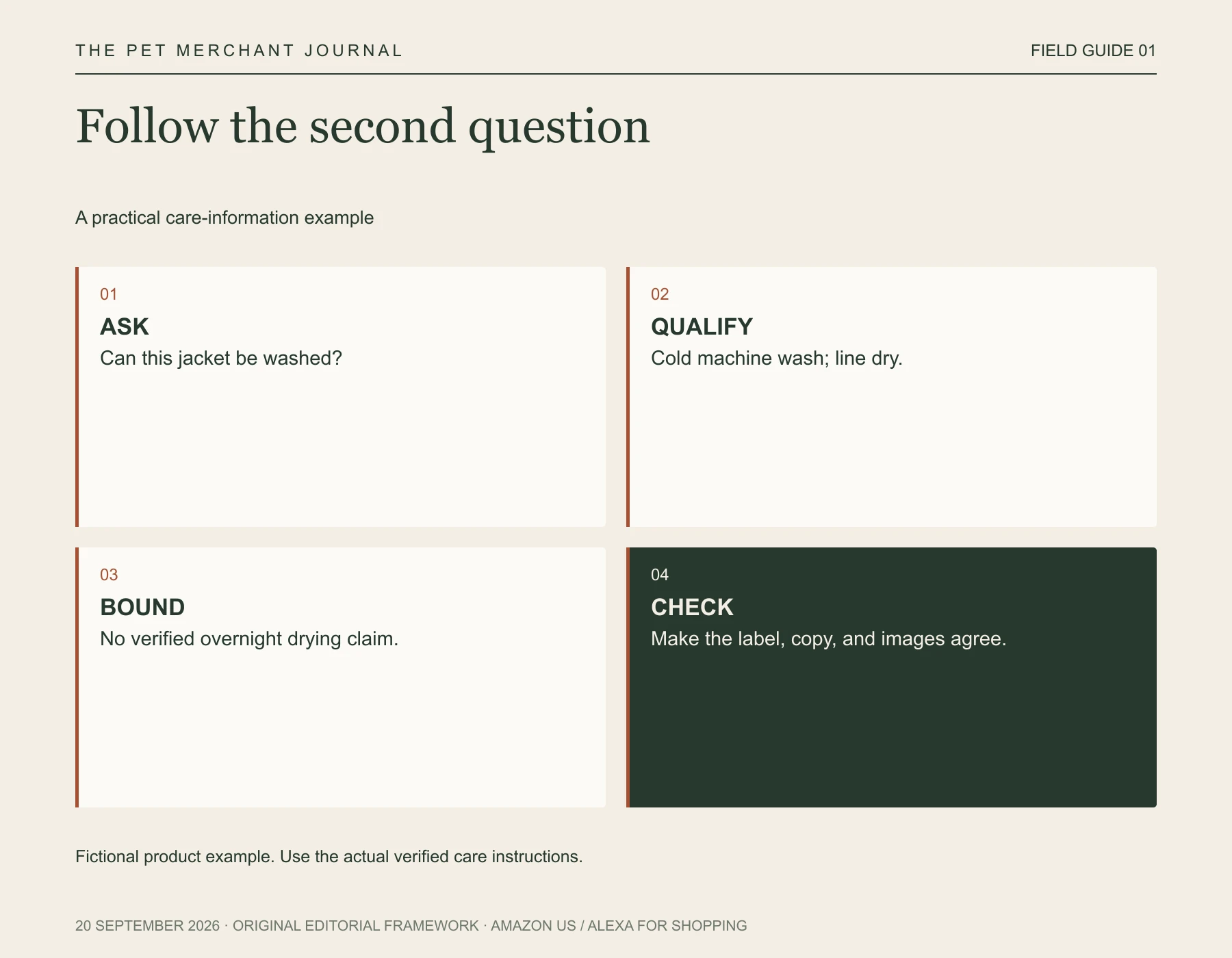
Original editorial framework. Fictional product example. Use the actual verified care instructions.
The sheet is an editorial tool, not an additional form the customer needs to complete. Its purpose is to expose the leap between a true fact and a convenient but unsupported conclusion.
The same exercise works with “adjustable,” “reflective,” “lightweight,” and “travel-friendly.” Ask which observable property supports the adjective. Then identify what the adjective does not establish. A reflective detail, for example, should not quietly become a promise about safety in every walking condition.
Put the answer where a person can find it.
Use the relevant product fields and readable copy available for the category. Keep the care label, written instructions, and product photographs consistent. If an image shows a method that contradicts the text, rewriting one bullet leaves the contradiction in place.
Write complete, economical statements. “Cold machine wash; line dry” is more useful than scattering “washable,” “convenient,” and “daily essential” through unrelated sentences. Preserve the conditions that make a statement true.
This is not a recipe for guaranteed placement in AI answers. Amazon describes an assistant informed by product knowledge, web information, and personal context. A seller's copy is not a private script for its response. Better facts make your listing more useful; they do not let you control what any individual shopper sees.
Check the answer as a shopper, then diagnose the gap.
Where the assistant is available, ask a genuine question about the product and compare the response with the current item and listing. Save the date, question, relevant answer, and the factual discrepancy you can actually demonstrate.
One response is a spot check, not a visibility report. If your own page is unclear, correct it. If the page is clear but an answer is wrong, use the available feedback or support route instead of adding repeated claims in the hope of forcing the outcome.
There is no need to publish an encyclopedia of hypothetical questions. Start with the questions that determine suitability, care, included parts, and use. A concise page with the right boundaries can be more helpful than a long page full of confident adjectives.
Your next useful content edit may be one sentence beyond “machine washable.” Follow the conversation far enough to find it.