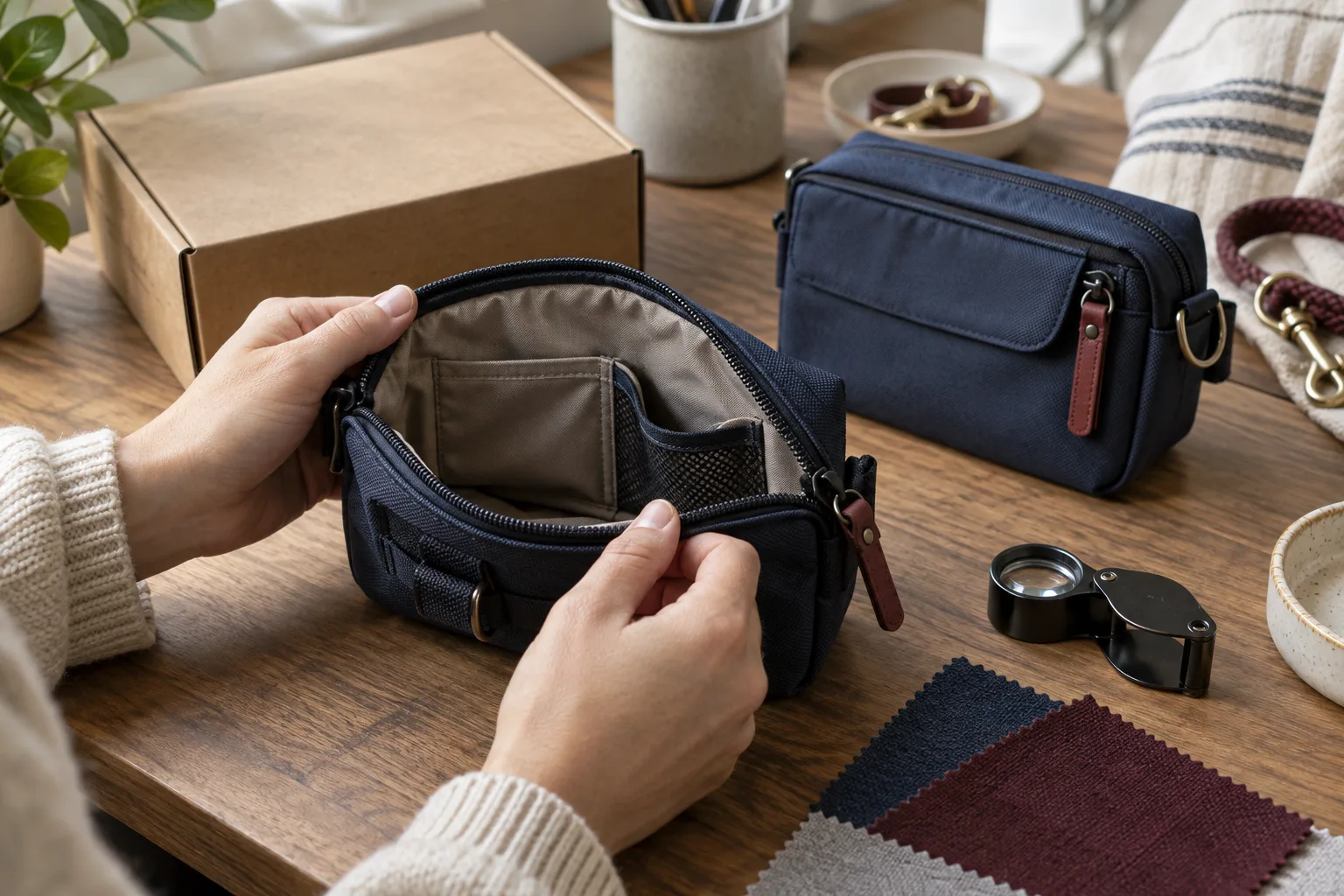
“My phone would not fit.”
“The zip keeps catching.”
“The strap was missing.”
These are invented complaints about one fictional dog-walking pouch. They describe three different disappointments. Sending all three to the photographer would give the team a full schedule and leave most of the work undone.
Customer feedback is useful partly because it breaks your internal categories. A buyer does not care whether the problem began in product development, content production, or fulfillment. They received one disappointing order.
The merchant's job is to put the problem back into a form somebody can investigate and fix.
Amazon's Product Opportunity Explorer can help identify themes worth investigating. Its Customer Review Insights groups feedback for products or niches, while its Returns view describes recurring reasons within a niche. Those perspectives can help you decide where to look. They do not diagnose the cause of a particular customer's experience.
Keep the observation separate from your explanation.
Start with the customer's wording and the relevant item. Record what is known: the selected product, the reported problem, any available order context, and whether the physical item has been inspected.
Then write your working explanation in a separate column. “The phone pocket is smaller than customers expect” is a hypothesis. “The customer reports that their phone would not fit” is an observation. Keeping both visible prevents a quick interpretation from hardening into a product requirement.
For our fictional pouch, assume the offer includes one pouch and a removable waist strap. It has an external phone pocket and a zipped main compartment. No complaint counts or outcomes are being claimed here; we are tracing the work each report should trigger.
Give each theme a next piece of evidence.
| Reported problem | What to check next | Possible owner |
|---|---|---|
| Phone would not fit | Pocket opening, usable space, phone-and-case dimensions, current imagery | Product and content |
| Zip keeps catching | Returned sample, lining position, closure operation, production batch | Product quality |
| Strap was missing | Included-item specification, packing record, physical contents | Fulfillment |
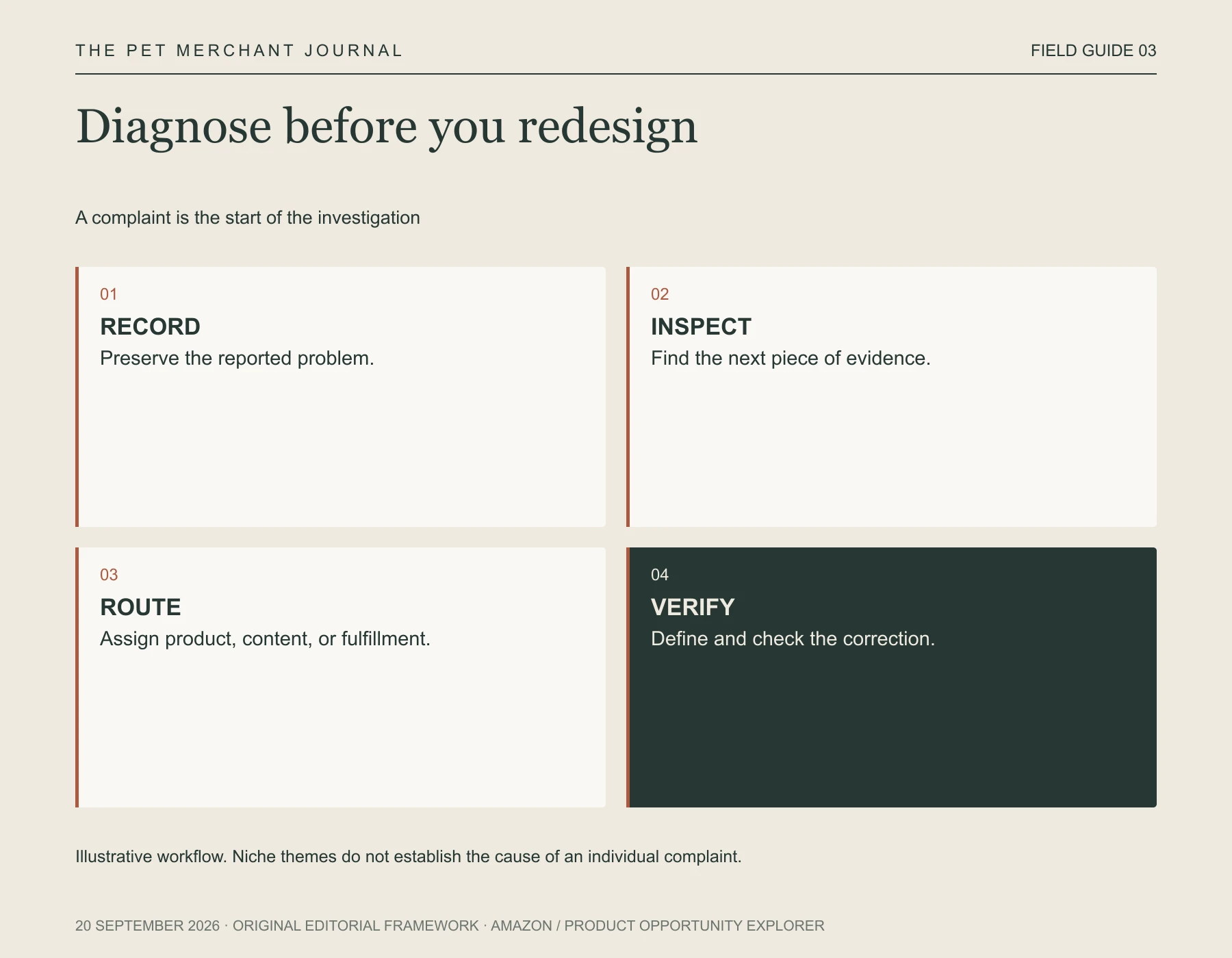
Original editorial framework. Illustrative workflow. Niche themes do not establish the cause of an individual complaint.
The first case might lead to clearer content. Perhaps the page shows a phone without identifying its dimensions, and a buyer assumes a larger phone in a thick case will fit. A measured pocket diagram and an accurate demonstration could improve the explanation.
But the same report might expose an assortment opportunity: the pocket genuinely fails to accommodate a use case your intended buyers care about. A better diagram cannot increase its usable space. You may need a revised design, a different target use, or both.
The catching zip deserves physical investigation. If the lining enters the mechanism during normal use, another cheerful walking scene adds nothing. Route the finding to the people responsible for construction and quality before rewriting the promise around it.
For the missing strap, first verify whether it was included in the offer. If it was, check the packing process and resolve the order through the appropriate service route. A larger “strap included” label would simply describe the unfulfilled promise more clearly.
Treat market themes as questions for your own business.
A common complaint in a niche can identify an issue to inspect in your product. It does not establish that your own inventory has the same defect. Equally, a theme mentioned within return data is not automatically the percentage of all buyers experiencing that problem. The denominator matters.
Amazon's current Product Opportunity Explorer overview describes using review and return information to inform products, listings, and campaigns. It also explicitly says the tool is guidance and does not guarantee an outcome. Use the views available in your account, then bring the investigation back to your own items and records.
Close a task with evidence, not a new file.
Define completion before assigning the work. For the pocket, the test might be that the documented dimensions and demonstration accurately show the usable opening. For the zip, it might be a checked construction correction against the relevant quality specification. For packing, it might be a verified process that includes the strap consistently.
Then monitor comparable feedback after the change, noting what else changed and allowing time for the revised items to reach customers. A quiet week is not proof that the cause has disappeared.
Prioritization still matters. One unusual preference need not trigger a redesign, and repeated wording can conceal different causes. Consider severity, available evidence, recurrence, and the cost of leaving the problem unresolved.
The next creative brief should emerge from that diagnosis. Sometimes it will ask for a precise photograph. Sometimes the most useful decision is to keep the camera in its case.