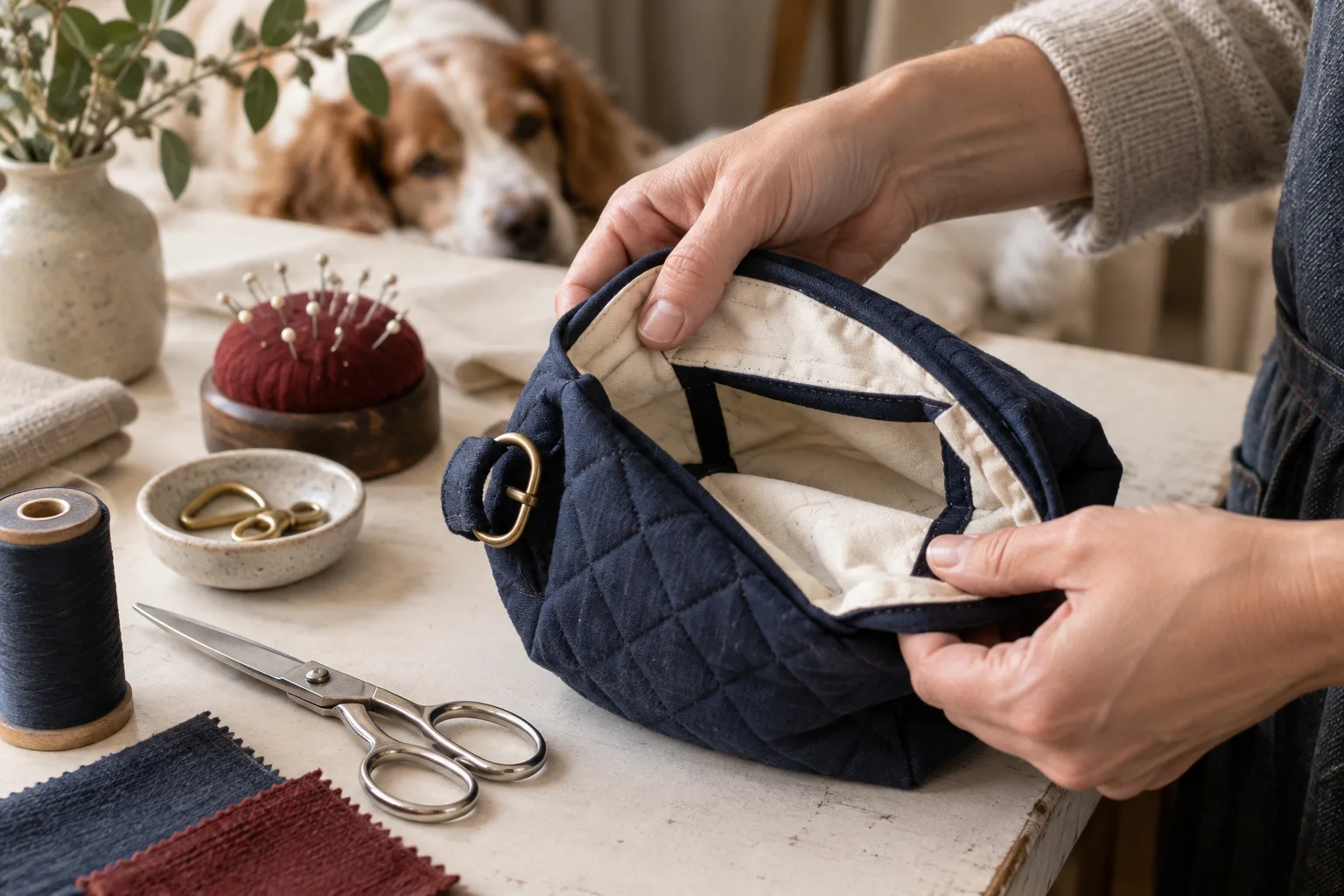
The outside of a quilted walking pouch makes the introduction. The inside can carry the argument.
Turn it over. Open it. Show the lining, the edge finish, the way the strap joins the body. These are modest gestures, but they give a buyer something specific to inspect when the listing describes an item as thoughtfully made.
“Handmade with love” may be sincerely meant. It leaves most of the workmanship invisible.
A seller knows which decisions took time. The customer sees a small object on a screen. The work of the listing is to connect those two views without turning every photograph into a plea for appreciation.
Make one construction choice visible
Consider an invented Etsy product: an indigo quilted pouch for carrying dog-walking essentials, with a cream lining, bound internal seams, a zip closure, and a detachable strap. These fictional specifications provide a gallery-planning example, not a performance claim.
The maker could photograph it beside a leash on a beautiful wooden bench. That establishes context. It does little to explain the construction.
Now add a close view of the inside edge, with enough surrounding fabric to show where the detail sits. The caption can state, “The internal seams are finished with binding.” That is a feature a buyer can understand and compare with the physical item.
Avoid jumping from the visible detail to an untested conclusion such as “will last a lifetime.” A clean seam photograph documents a seam. Durability requires its own basis.
Etsy's product-photography guidance describes detail shots as a way to show material texture and features, and process shots as a way to communicate workmanship. The useful editorial choice is deciding which specific detail deserves that attention in your product.
Follow the feature from making to use
For the fictional pouch, build a short sequence around the lining and opening:
| Frame | What it establishes | What to keep clear |
|---|---|---|
| Finished pouch | Shape, color, and complete offer | Whether the strap is included |
| Open interior | Lining and usable compartment layout | The actual opening and scale |
| Construction detail | Binding and stitching at a named location | Enough context to recognize the part |
| Making moment | The relevant operation in progress | The real product and the work you perform |
| Use demonstration | How the closure and strap operate | The exact attachment arrangement |
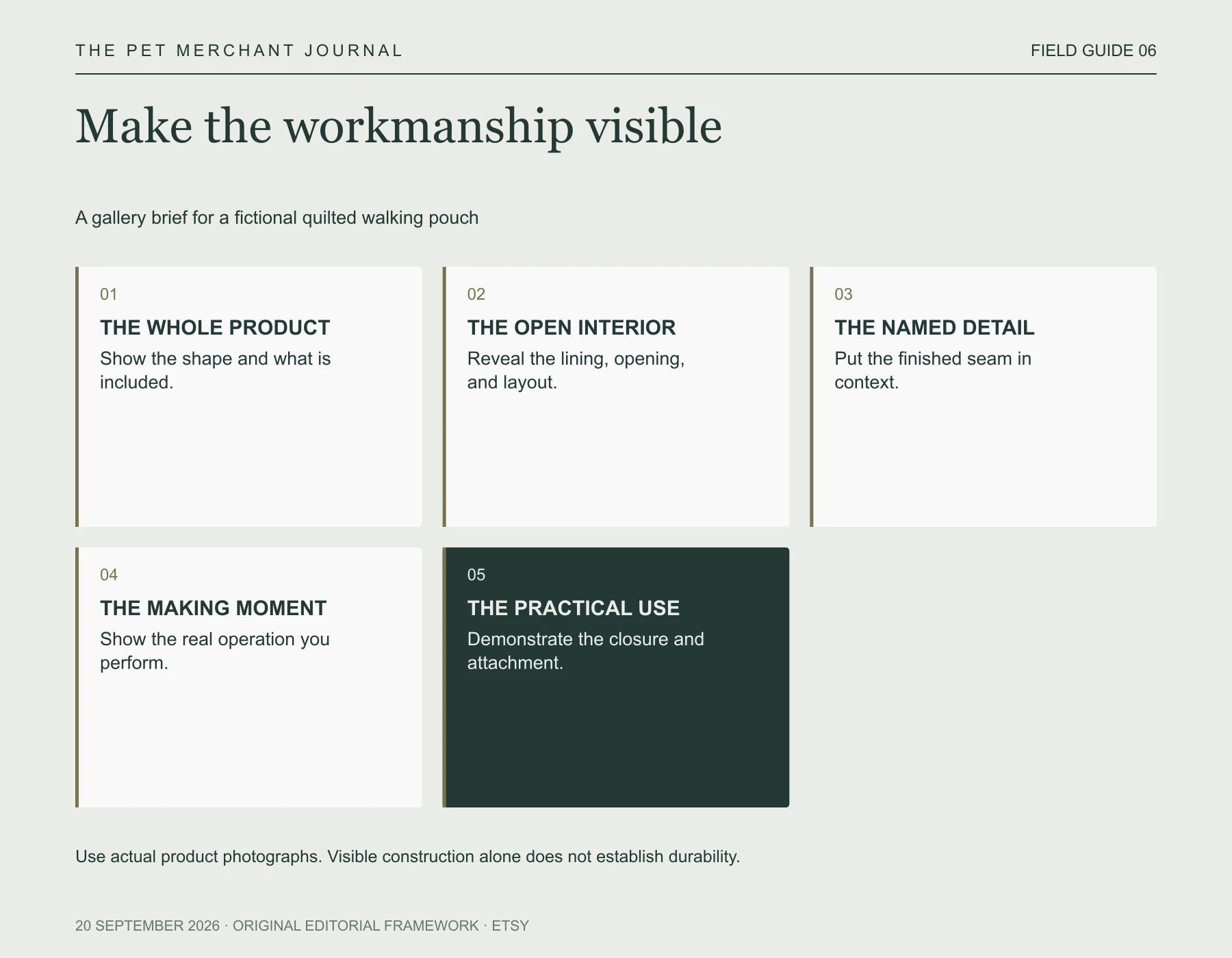
Original editorial framework. Use actual product photographs. Visible construction alone does not establish durability.
Photograph the process that explains the feature. A hand guiding binding around an edge has a clear relationship to the finished interior. A decorative pile of scissors and thread may create atmosphere, but the buyer still needs to see what those tools accomplished.
You do not need to reveal an entire pattern or every production step. Select a moment that makes your contribution understandable. If another person or a production partner performs part of the work, describe the roles accurately; the image should not imply a different origin story.
Etsy's listing-image policy generally requires original photographs of the actual finished product, with specified exceptions. For an ordinary handmade pouch, real product and process photography provides the appropriate evidence. An AI illustration of hands at a sewing machine cannot document who made a particular item.
Let the explanation respect the buyer
The price should not depend on the customer agreeing that every hour was difficult. Explain what the choices produce: a particular finish, an opening arrangement, a removable part, a material, a shape. Support the features you claim and let the customer decide which matter to them.
Some buyers will prioritize a lower price or a different function. That is a useful counterpoint to the instinct to add more craft storytelling whenever a sale does not happen. More explanation cannot make the product the right choice for everyone.
Keep practical information close to the beautiful details. A carefully bound interior still needs dimensions, contents, care instructions, and a clear description of what arrives. If the pouch is not designed for loose food, say how it is intended to carry supplies rather than staging unwrapped treats inside it.
Use the camera before adding another adjective
At the next making session, capture the finished piece and one relevant operation under consistent light. Then review the photographs without the words “premium,” “quality,” or “artisan.”
Can a person unfamiliar with your craft point to the decisions you want them to value?
If they can, write the caption around what they found. If they cannot, move the camera closer to the work.
The inside of the pouch was always part of the product. Give it a place in the offer.