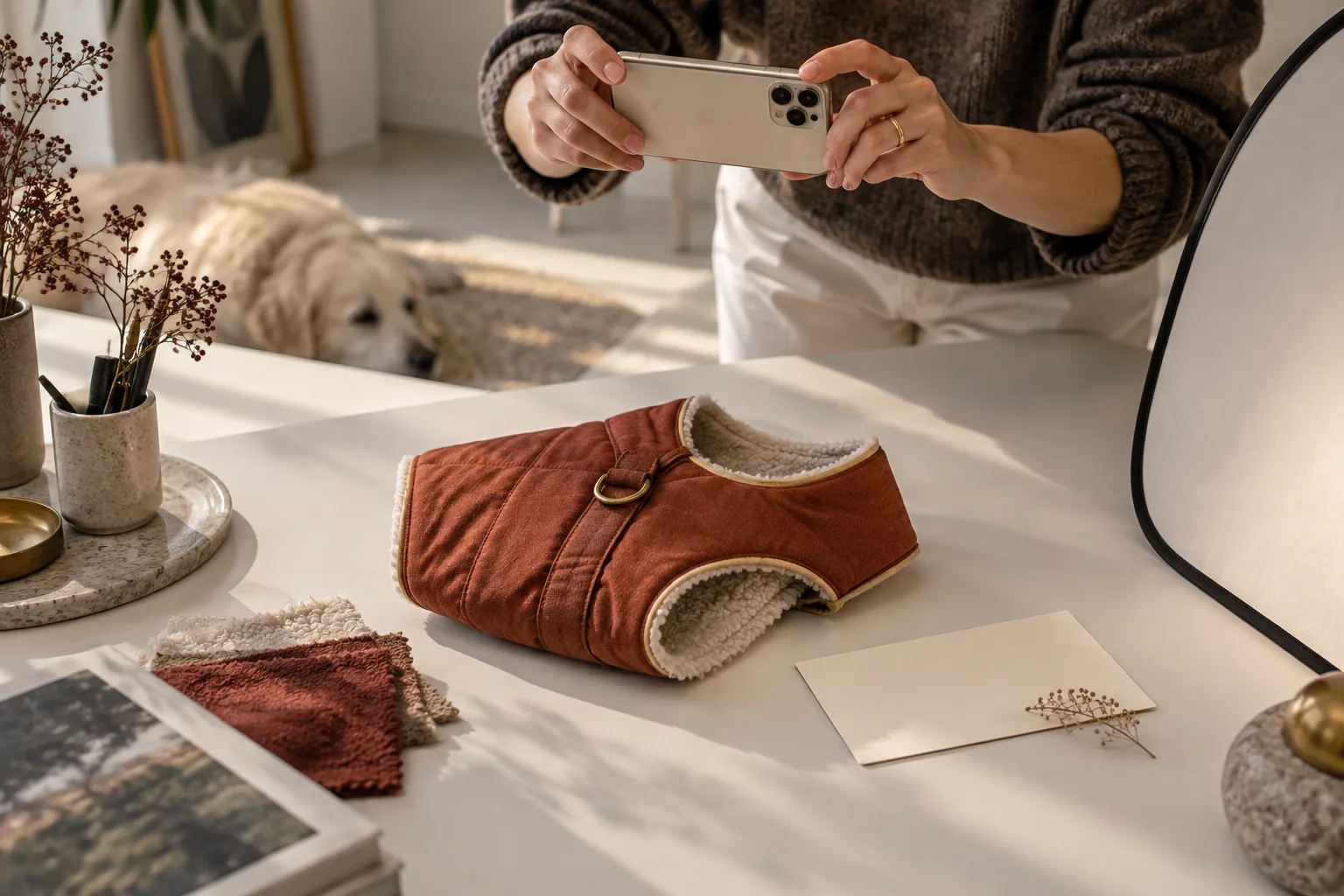
The brief arrives with a finished hook, twelve required phrases, a prescribed facial expression, and a request to make the video feel natural.
It contains everything except the answer to the creator's first practical question: which size should they put on their dog?
For a pet merchant, the most useful creator brief begins before the script. It gives the person holding the product a reliable understanding of what they can show, what they can say, and what remains their creative decision.
That approach fits TikTok Shop's US guidance on accurate, original promotional content. The platform asks creators to represent the listed product accurately and contribute their own perspective. A merchant can support both by making the facts firm and the presentation flexible.
Start with the sample they will actually receive
Imagine a fictional reversible dog vest: terracotta on one side, a fine stripe on the other, with three snap fasteners. One vest is included. For this example, assume those details agree with the inspected sample and product information.
Send the selected size, its verified measurements, care instructions, current listing details, and photographs of both sides. Explain how the sample relates to the version being promoted. Ask the creator to check the dog’s measurements before filming; a beautiful first take cannot resolve the wrong garment size.
Then identify the useful buying question: “Would two genuinely different looks make this vest more useful to me?”
The creator now knows what the merchant hopes viewers will understand. They can decide how to make that question feel relevant to their audience.
Write a short boundary around the claim
For the fictional vest, a fact might be: “The same garment can be worn with either side facing out.” A visible feature might be: “Three snaps run along the fastening.”
Neither statement establishes that the vest is waterproof, suitable for every dog, or comfortable for an entire day. If the merchant has no supporting information for those claims, the brief should say so directly.
Do the same for experience. A creator can describe what they actually observed, in their own words. Do not supply “my dog loves this” as a compulsory line before the creator has received the product. The brief should leave room for a fit issue or an observation the brand did not anticipate.
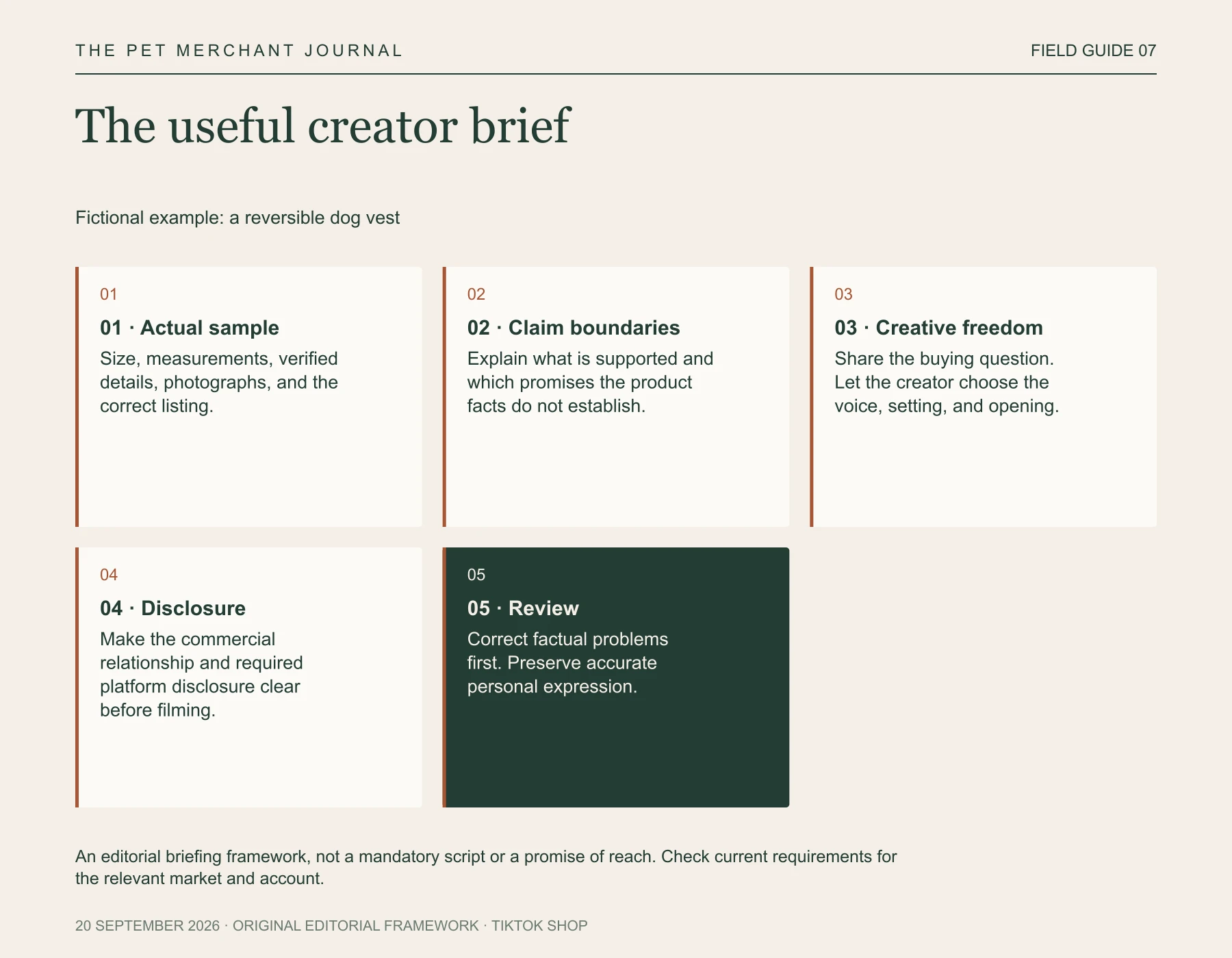
Original editorial framework. An editorial briefing framework, not a mandatory script or a promise of reach. Check current requirements for the relevant market and account.
Give them creative choices that matter
One creator might frame the vest as a packing choice for a weekend away. Another might show how the two sides change the appearance of the same walking outfit. A third might begin with the fastening because their audience often asks about putting garments on dogs.
These are possible angles, not testimonials to copy. Let the creator choose the setting, opening sentence, pace, and humor. Ask for the garment to remain recognizable and the relevant product information to be understandable.
Avoid filling every second with brand language. If a fact is essential, state the information that must survive the edit. Leave the wording open unless precise wording is necessary for accuracy.
Put the commercial relationship in the brief
For a collaboration involving payment, commission, or another incentive, handle disclosure before production. TikTok's help guidance requires the content disclosure setting for promotional posts, including third-party promotion in exchange for payment or another incentive. Third-party branded posts use the Paid partnership label; a business promoting itself uses Promotional content.
Make that requirement part of the practical handoff. An authentic voice and a visible commercial relationship can coexist. Do not ask the creator to make an arranged collaboration resemble an unsolicited discovery.
Also agree which account will publish, when the product information will be checked again, and what use of the finished footage is actually included in the arrangement. A creator's organic post and permission to use footage elsewhere are separate operating questions to resolve.
Review the facts before rewriting the personality
Give feedback in two passes. First, correct consequential issues: the wrong linked product, an unsupported claim, an unclear inclusion, or missing disclosure. Second, assess whether the story communicates the intended buying question.
If the creator's phrase is accurate but sounds unlike your brand copy, that may be precisely why you commissioned a creator. Explain a genuine misunderstanding; avoid replacing every personal sentence with a slogan.
There are times for a tighter script, especially when a complex explanation needs careful wording. Even then, distinguish the parts that protect accuracy from the parts that merely reflect the merchant's taste.
Before sending the next brief, read it as someone seeing the product for the first time. Can they identify the item, understand its limits, and imagine a story of their own?
That is a stronger starting point than asking twelve approved phrases to sound spontaneous.