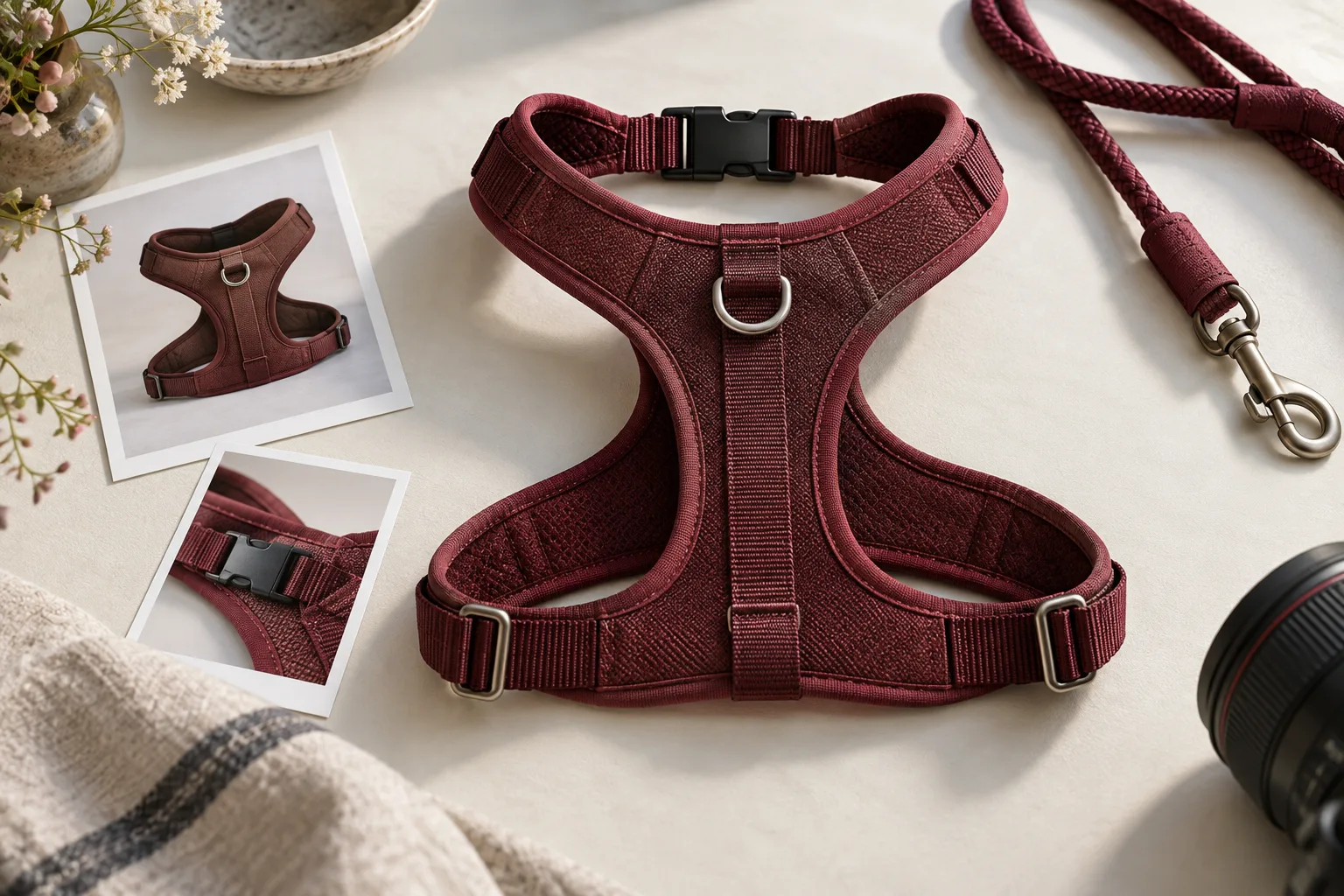
The buckle is partly hidden by a hand. One strap disappears into shadow. The product is folded in a way that makes its front and back difficult to distinguish.
Now ask an image generator to show that harness on a dog from the opposite side.
The brief has requested more than a change of setting. It has requested a view that the reference does not establish. The result may look convincing while resolving those missing details differently from the physical product.
Before another round of increasingly elaborate prompts, inspect what you have actually supplied. A creative brief cannot turn an unseen fastening into verified product evidence.
This is a useful starting point for a small pet brand because it changes the next action. Sometimes you need a better description. Sometimes you need one more photograph. Sometimes the product team needs to confirm what the item is before anyone generates another scene.
Consider an illustrative oxblood step-in harness with two leg openings, a back closure, and a separate leash. The only available image shows the harness folded beside the leash on a dark table. The desired scene is a side view of a dog wearing the harness outdoors.
The photograph gives the team a mood and a color impression. It does not clearly explain the harness's construction or demonstrate how it sits on an animal. Those are different kinds of information.
Prepare the smallest useful reference pack.
Start with a clear whole-product view. Lay the harness out so its overall shape and visible strap connections can be understood. Photograph the other side separately. Keep the source files attached to the correct item and version, rather than collecting every photograph into a folder called “new products.”
Then capture the detail most likely to be misread. For this harness, that might be the closed back fastening and the same fastening opened. For another product, it might be a detachable bow, a lining, or a leash opening. The useful extra image answers a specific uncertainty; it does not merely repeat the hero shot from a slightly different angle.
Keep a controlled color reference. Use consistent lighting and retain the original image for comparison. A phone photograph and a screen still have limits, so do not treat the process as a color certification. It is a way to avoid asking several people to approve different interpretations of the same item.
Separate scale from styling. Record verified dimensions and the measurement method in the product information. If an actual worn example is available, document that particular setup. An AI-generated dog is not a sizing instrument, and an attractive pose does not establish comfort or compatibility.
Finally, identify what belongs in the package. In our example, the harness and leash are sold separately. Put that distinction in the brief before the coordinated scene makes them look like one offer.
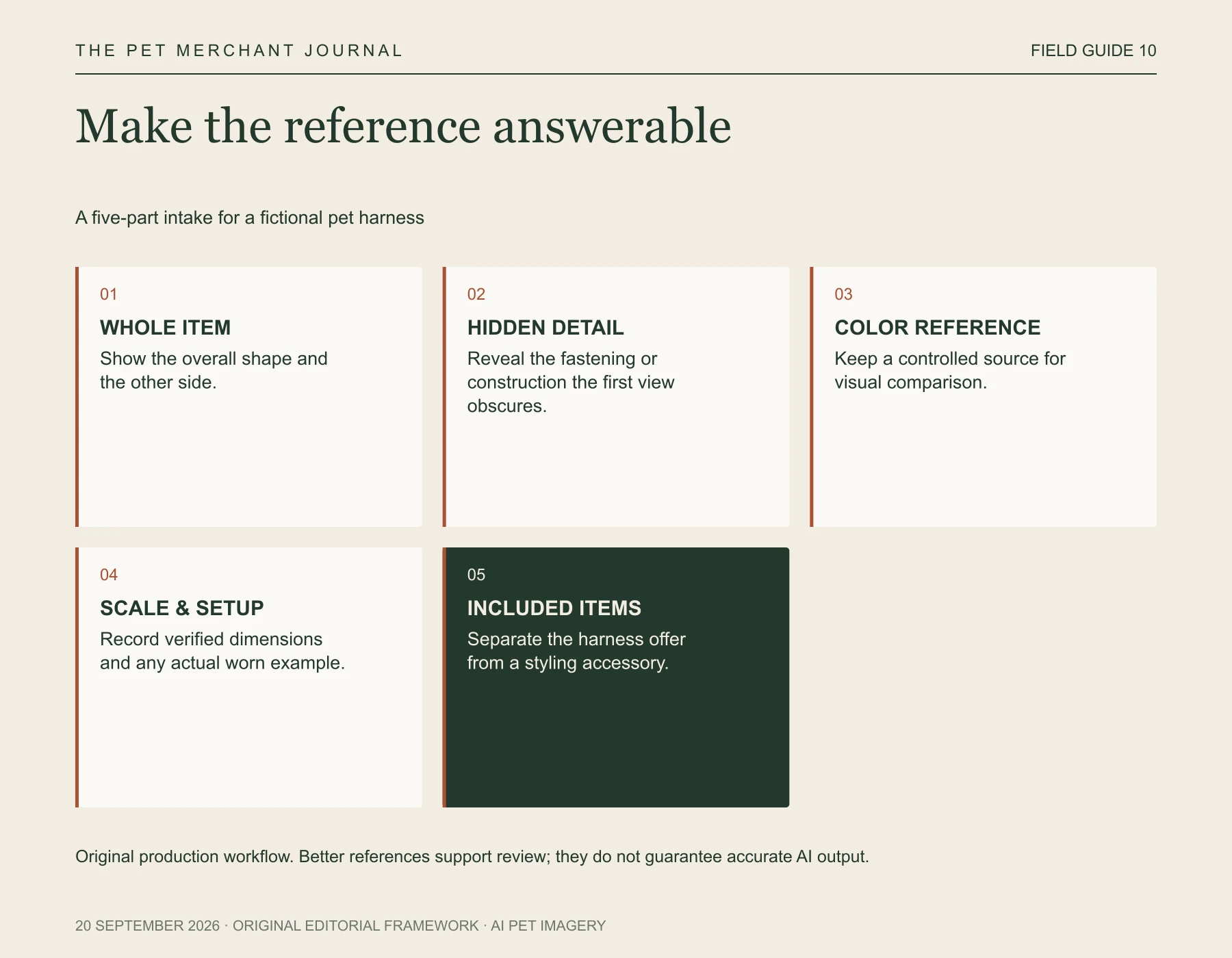
Original editorial framework. Original production workflow. Better references support review; they do not guarantee accurate AI output.
Shopify's current media-generation guidance recommends clearly visible subjects, good contrast, clean edges, and simple compositions for background removal. Its product-photography guide likewise starts from a clear, well-lit reference image. These are useful input principles. They do not amount to a guarantee that any generated garment, closure, or fit will remain accurate.
Ask for a scene you can evaluate.
Once the evidence is assembled, write the creative request in two parts. First describe the setting: a quiet urban doorway, soft morning light, an uncluttered composition. Then list the product facts that must be checked in the result: the fastening, strap arrangement, color, and included items.
An instruction to preserve those details is a requirement for the review, not proof that the tool has fulfilled it. Keep the approved references beside the output and reject a beautiful scene when it changes the item.
That is how we would brief a pet-styling workflow with our project, Tufty: useful source material first, a specific visual direction second, and merchant approval against the real product before publication. Platform-specific image rules still determine where a finished asset can be used.
There is also a sensible limit to preparation. You do not need an elaborate studio archive for every simple accessory. Start with the view you need, identify what is obscured, and capture the smallest additional evidence that resolves it. If a straightforward photograph already answers the buying question, use it.
On the next rejected image, write down the reason before generating again. Was the source unclear? Was the instruction ambiguous? Did the output depart from a clearly supplied fact? Each answer calls for different work.
The next improvement may be a better prompt. It may also be thirty seconds spent unfolding the harness.