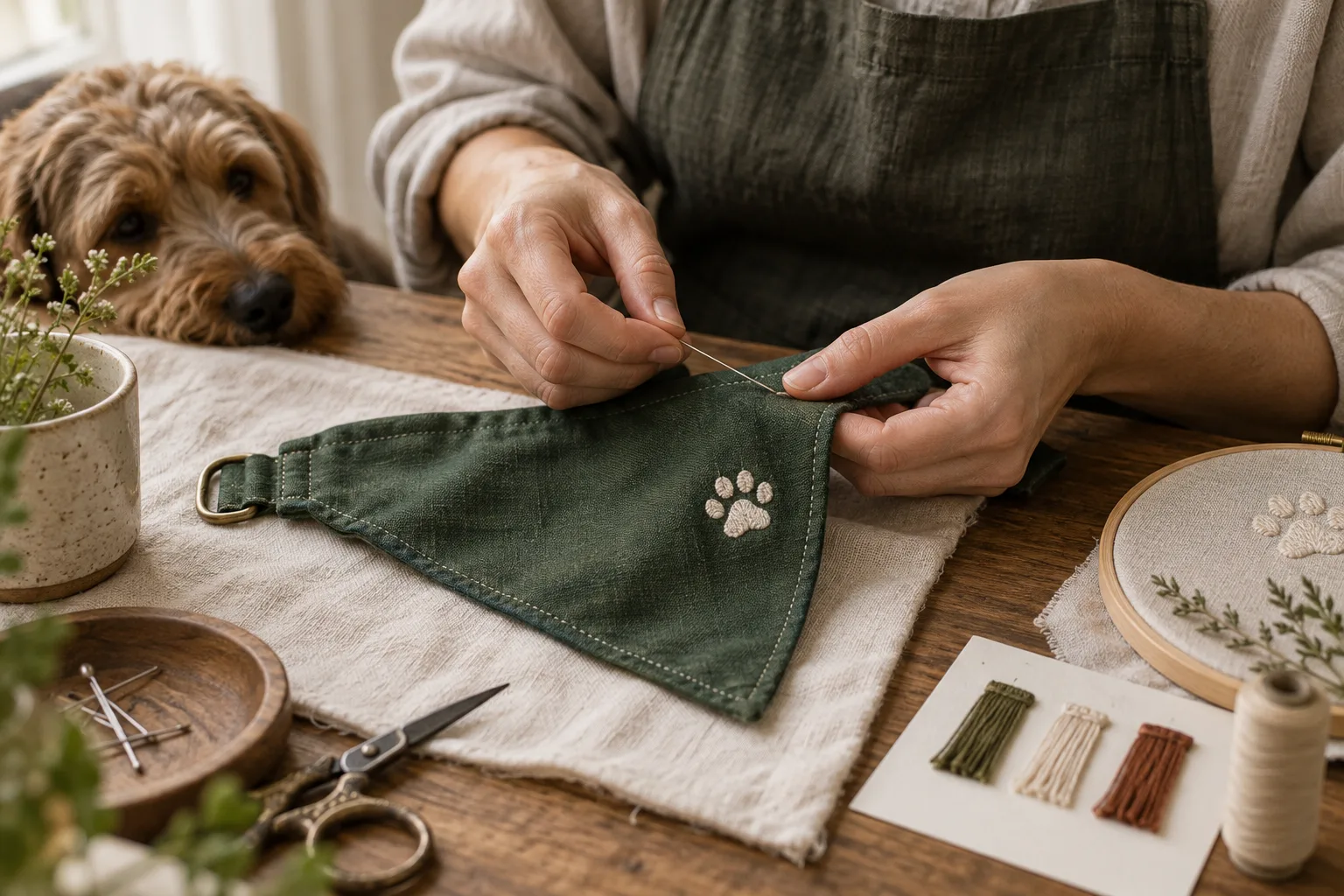
“Exactly like the photo, with my dog's name.”
A customer can write that sentence with complete confidence while imagining something different from the seller. They may mean the same lettering height. The seller may mean the same font. They may expect the name to occupy the same width. A longer name makes that impossible without changing something.
Personalization creates value by making an item feel specific. It also creates a second product to manage: the customer's expectation of the finished result.
For a pet accessories merchant, the useful question is therefore bigger than “Have we added a personalization field?” It is: can the buyer describe what will arrive, using the same language the person making it would use?
Consider an invented listing for a forest-green, slide-on dog bandana with cream embroidery. The sample says MILO. Buyers can choose their dog's name and one of three thread colors. The product sounds simple enough. Now imagine the order says SIR WELLINGTON, asks for “the gold in the picture,” and selects the smallest bandana.
The expensive work starts wherever the listing left room for interpretation.
Photograph the agreement
Etsy's image rules require a finished customized item similar to what the buyer will receive in the first image for personalized products. A blank item or placeholder-text mockup cannot serve as that main image; additional images may show computer-generated customization options. Etsy also requires original product photographs outside its stated exceptions.
That gives the merchant a productive creative constraint: make the first image a beautiful, achievable promise.
Photograph the actual MILO sample close enough to reveal the stitching, but far enough away to establish the whole bandana. Follow it with a second real sample carrying a longer name. The difference between those two images can explain your lettering system better than a paragraph about proportional scaling.
A third frame can show the reverse side, sleeve opening, and finish. A fourth can compare the actual thread options under consistent light. A brief process image can show the embroidery being made. Each frame earns its place by answering a different question about the order.
A polished scene has value. So does the unglamorous underside that explains how the product is constructed.
Give each choice a job
Etsy's current personalization guidance separates custom inputs from inventory-based variations, recommends requesting one detail per field, and says image labels should match the available choices. Apply the controls present in your shop rather than relying on an old setup tutorial.
For the invented bandana, define the offer before configuring the form:
| Decision | What the customer sees | What production receives |
|---|---|---|
| Base item | Bandana size and forest-green fabric | The correct stocked base |
| Name | Exact spelling and permitted characters | Text reproduced as submitted |
| Thread | Cream, rust, or slate, matched to photographed swatches | One named thread reference |
| Layout | One line; lettering adjusts within a stated area | A repeatable placement rule |
| Approval | Whether a proof is included and what it covers | A clear point when production may begin |
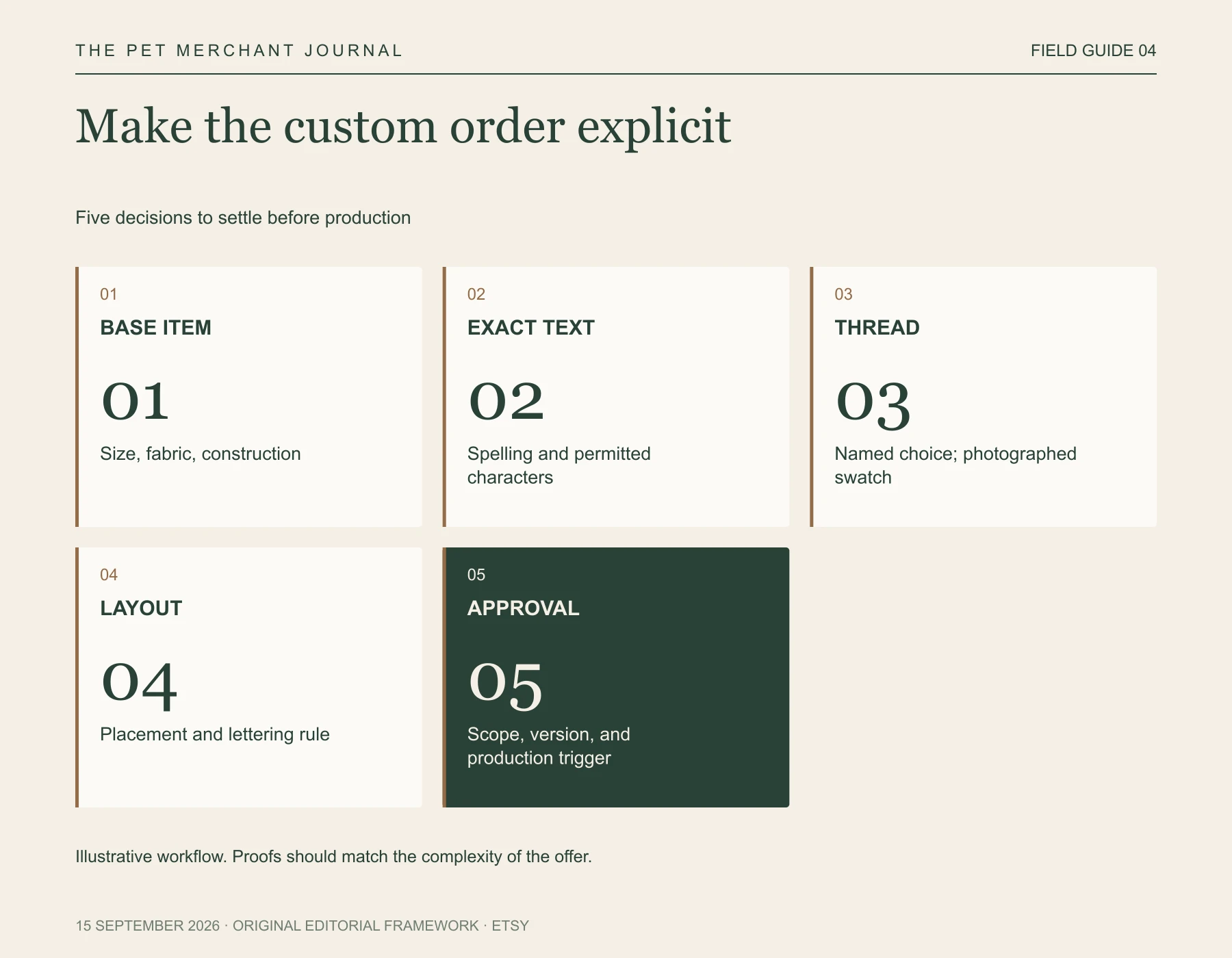
Original editorial framework. Illustrative workflow. Proofs should match the complexity of the offer.
The table is an operating model, not a requirement to add five fields. A fixed layout can live in the description. The important part is that no decision exists only in the maker's head.
Decide what a proof actually proves
If you offer a preview, explain its scope. A spelling-and-placement proof can confirm text and layout. It cannot establish the exact tactile finish of embroidery or guarantee that a screen reproduces thread color perfectly.
Define the included revision process, expected response window, and what happens if the buyer does not reply. Make those terms consistent with your actual workflow and the platform's requirements. An approval message should identify the version being approved; “looks good” is much less useful when three previews are sitting in the conversation.
There is a sensible counterpoint: proofs are not automatically good service. Requiring approval for every straightforward name order can introduce delay and create work the customer did not want. A tightly defined standard offer may work better with accurate examples and explicit instructions. Reserve additional consultation for changes that truly need it.
We are developing Tufty around AI pet outfit visuals. For a personalization business, any such concept image should stay clearly separate from the production evidence and the customer's approved specification. The more convincing the illustration, the more carefully that distinction needs to be maintained.
Before improving the styling of your next personalized listing, give it to someone unfamiliar with the product. Ask them to place an imaginary order and describe the result, including lettering, placement, construction, and timing.
Every answer they have to invent is a decision your listing still needs to make.