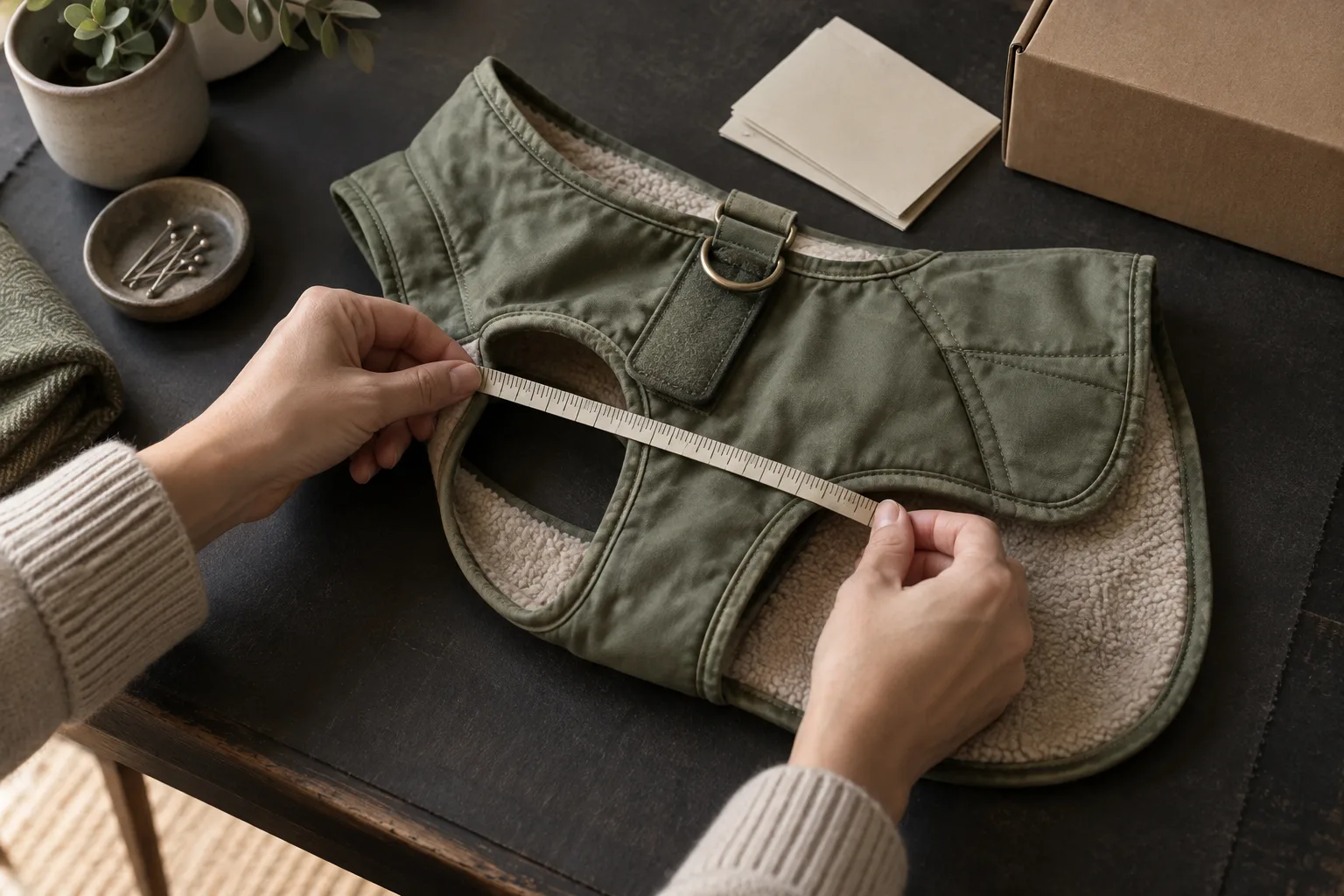
“Chest: 48 cm.”
The sentence is easy to translate. The decision is harder. Does 48 cm describe the dog's body, the finished garment, or the garment stretched? Is the measurement taken around the chest or across fabric laid flat? Should the customer add room, or has the suggested range already allowed for it?
Changing “chest” into another language leaves every one of those questions intact.
For a pet apparel merchant selling across borders, localization starts with the information a customer needs to choose correctly. Language comes after the underlying meaning has been made explicit.
Translate the measurement, then the label
Imagine a sage-green dog coat sold in three sizes. This is an invented example, not a fit recommendation. Its product team has documented a sample in the middle size with a 48 cm finished chest circumference, a 32 cm back length, and a 36 cm finished neck opening. Those figures describe the garment under a defined measurement method. They do not establish which dog should wear it.
A usable international specification preserves that distinction:
| Sample measurement | Master value | Converted display |
|---|---|---|
| Finished garment chest circumference | 48 cm | 18.9 in |
| Back length, using the documented endpoints | 32 cm | 12.6 in |
| Finished neck opening, garment unstretched | 36 cm | 14.2 in |
Illustrative sample dimensions; inches rounded to one decimal place. These are garment dimensions, not a recommended body-size range.
The conversion uses 1 inch = 2.54 centimeters. Keep one master measurement set and derive the second unit from it, so later edits cannot leave two competing charts.
A real listing also needs the merchant's verified sizing guidance: the body measurements to take, the measurement points, the intended fit, and what to do between sizes. Do not invent a universal allowance or use breed names as a substitute for that work. Two dogs described by the same breed can still need different sizes.
An inch conversion makes a number easier to read. A measurement method makes it useful.
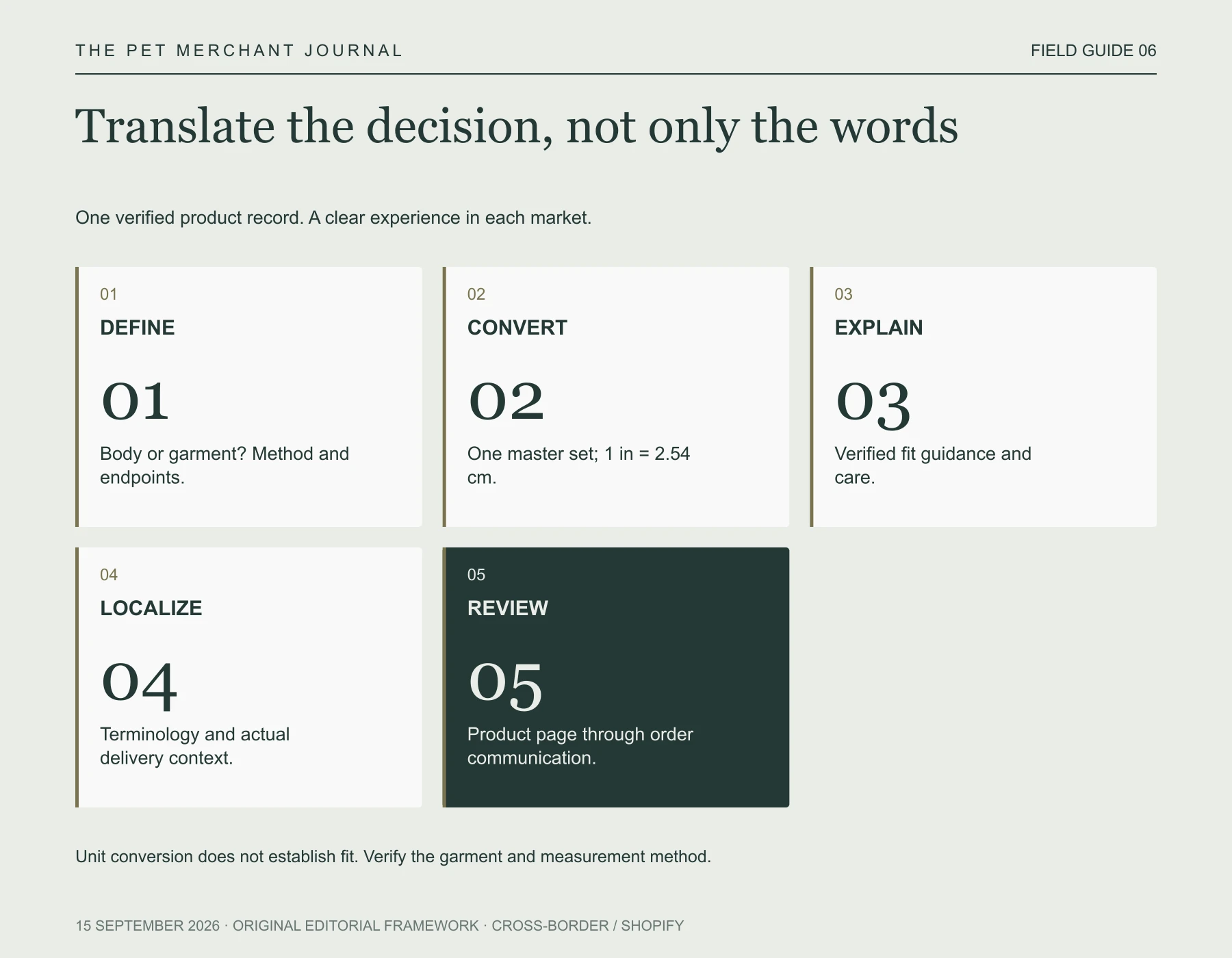
Original editorial framework. Unit conversion does not establish fit. Verify the garment and measurement method.
Localize the questions around the purchase
The same discipline applies beyond sizing. Start with a single SKU and write down the decisions surrounding it.
Can the buyer identify the material and understand the care instructions? Does “dispatch” mean the date production ends or the date the parcel enters the carrier's network? Is a delivery estimate expressed as a clear date range? Can the buyer find the return instructions relevant to the destination and the product being purchased?
These are content questions that need coordination with the people fulfilling orders. A translator cannot resolve an undefined production promise.
Separate three layers. Product facts remain tied to the SKU. Presentation changes for the audience. Commercial terms follow the actual market setup. If a coat is a polyester blend, that fact should survive every language. If a market expects a different term for the garment, the label can change. If the shipment route changes, the delivery information must reflect the route rather than reuse the domestic estimate.
Shopify's localization guidance explains that missing translations can fall back to the store's primary language, and that language support depends on store and theme configuration. Publishing a language therefore is not the same as reviewing the entire buying journey in that language.
A language is not a market
Two destinations can share a language while differing in season, delivery timing, product availability, and familiar terminology. Treat those as details to verify, rather than national stereotypes to build a campaign around.
Shopify's Translate & Adapt documentation describes market-specific content, including adaptations within the same language, and notes that some content types are unsupported. Check the actual resources your store uses, especially material embedded in images or supplied by other apps.
A measurement diagram may be perfectly translated in the description while its image still carries the old labels. A size selector may use one naming scheme while the chart uses another. Inspect the rendered page on mobile, not only the translation spreadsheet.
Keep the first release manageable
There is a practical argument against rewriting an entire catalog for every destination: it can create more versions than a small team can maintain. Begin with one product and one market. Review the path from collection to product, size selection, cart, checkout, and order communication. Have a fluent reviewer explain the product and buying terms back to you.
If we explore a localized campaign concept in our project, Tufty, its AI pet outfit imagery should remain illustrative. The fit demonstration and measurement diagram must remain grounded in the real garment and a verified method.
Before approving another translation, ask a harder question: could a customer use this page to make the same informed choice you would make with the product in your hands?