The navy coat looks excellent. The terrier is charming. The fabric texture reads beautifully on a phone.
Then the customer selects Medium. The color changes. The gallery still shows Small. The delivery estimate is less convenient than expected. Somewhere between liking the image and choosing the item, the offer has become difficult to understand.
It is tempting to commission another shoot. First, open the listing as a buyer and try to purchase the exact version you intended to promote.
For merchants on Walmart Marketplace in the US, this exercise has a practical foundation. Walmart's Listing Quality guidance treats content, price competitiveness, shipping, published availability, and ratings and reviews as separate components. An image can improve the presentation while leaving other problems unresolved.
Start with one product family
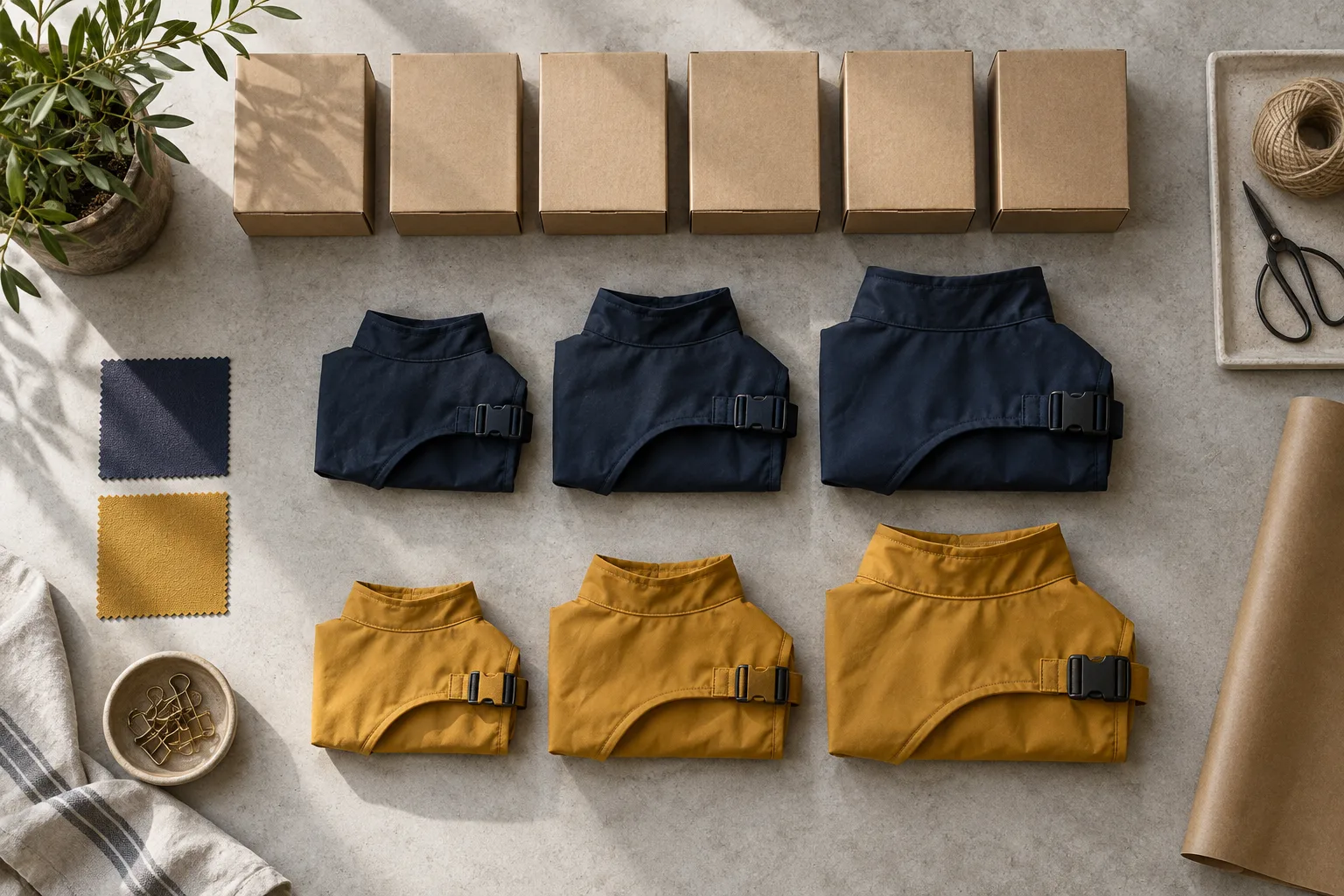
Imagine a fictional dog raincoat offered in two colors, Navy and Ochre, and three sizes, Small, Medium, and Large. There are six sellable combinations. The materials and basic construction are the same; dimensions and color identify the differences.
Before generating another lifestyle scene, create a working record with one row for each combination. Record the merchant SKU, valid product identifier, color, size, measured dimensions, correct image set, stock, price, and shipping configuration. The record is an internal reconciliation sheet, not a replacement for Walmart's category-specific setup fields.
The useful question is whether each row describes one item that your warehouse can actually pick.
For example, RC-NV-M should point to the navy Medium coat, its measurements, its photographs, and its available units. If your inventory calls the color “Midnight” while the listing calls it “Navy,” document the relationship. A creative color name should not require a packer or customer to guess.
Do the same for RC-OC-M. Resist copying the navy images into that row as a temporary measure that nobody owns the task of replacing.
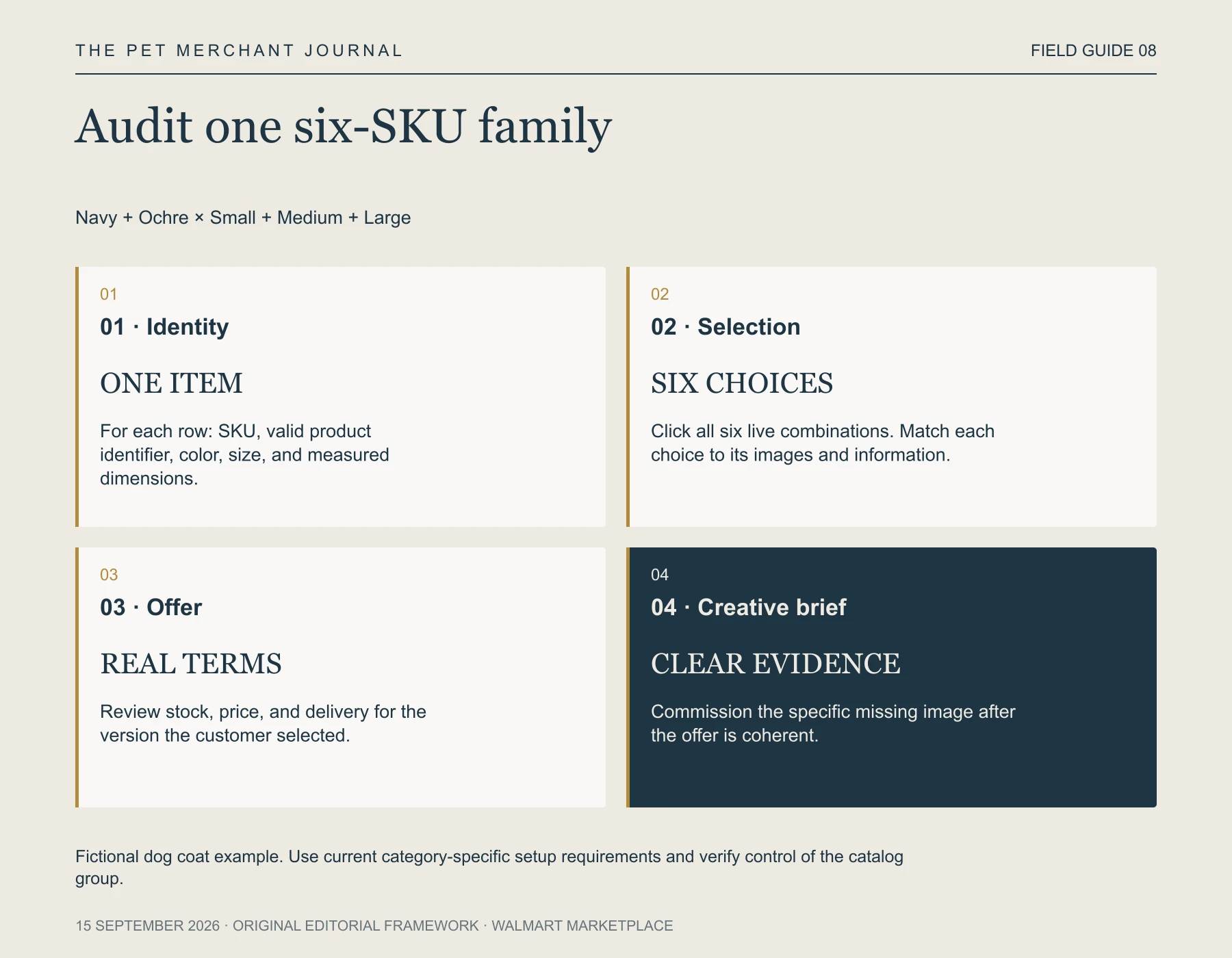
Original editorial framework. Fictional dog coat example. Use current category-specific setup requirements and verify control of the catalog group.
Treat the selector as part of the product page
Once the six rows agree internally, inspect the live color and size choices. Select every sellable combination. Record which image, price, availability, and delivery information appears. Check the result on a phone as well as a larger screen.
The point is to follow a customer's sequence, rather than approving six files in a folder. A correct photograph attached to the wrong selection remains a problem for the buyer.
Walmart requires each variant item to have its own identifier and a distinct combination of variant values; duplicate variants can lead to unpublishing. It also explains that groups may be merged with existing catalog groups and that sellers cannot edit items in groups controlled by Walmart. Catalog ownership and control therefore matter when a correction does not appear.
For our fictional coat, that means verifying the actual group before treating a stubborn selector as a design problem. If the group is controlled elsewhere, use the relevant support route with the affected item identifiers and a clear description of the mismatch.
Separate three different kinds of work
Suppose the navy Medium shows the correct garment but lacks usable measurements. That is an information task: obtain and publish the appropriate verified sizing details.
Suppose the ochre Large is unavailable. That is an assortment or inventory decision: decide whether to replenish it, change the campaign emphasis, or accept that this option cannot carry the promotion today.
Suppose all six versions are correct and available, but the images obscure the fastening. That is a content task: photograph the closure and show how it works.
Calling all three “listing optimization” can hide who needs to act. Give each problem an owner, the affected SKU, and a concrete completion test. “Customer can select ochre Large and see the matching item” is more useful than “improve variants.”
Do not optimize the dashboard at any price
The counterargument is fair: merchants also need desire. Complete data and reliable fulfillment do not automatically create a memorable brand. Distinctive images still help a shopper understand a coat's appearance and feel interested in it.
But the next investment should follow the actual constraint. A better photograph may be worthwhile after the selector works. A faster delivery option may be worthwhile when its full cost fits the offer. A lower price should be evaluated against contribution, not chosen merely because it changes a score.
Review the six-SKU family again after making a change. Confirm that the correction appears, the intended version can be selected, and the commercial terms remain sustainable. Dashboard updates and catalog processing may take time; keep a dated record of what you submitted and what buyers can see.
The best brief for your next creative project may come from this review: one specific image, for one specific uncertainty, on an offer that is already coherent.
That is where good merchandising and good operations meet—at the moment a customer can confidently choose the right coat.