
A gift set can look completely ready while being impossible to ship.
The photography is finished. The sweater and bow tie share a beautiful color palette. The box has tissue paper that catches the light. Then the first orders arrive, and someone discovers there are far fewer gift boxes than sweaters.
That is a useful problem to solve in September. It becomes a very expensive creative revision in November.
For pet brands preparing a holiday assortment, the strongest starting point is a purchase someone can make confidently. A beautiful theme matters after the customer understands who the gift is for, which choices they must make, and what will actually arrive.
Start with the gift-giver's missing knowledge.
A dog owner may know their pet's measurements. Their colleague probably does not. A size-dependent sweater set creates a different buying task from a gift card or a product with fewer fit decisions. “For dog lovers” is too broad to resolve that difference.
Divide the shopping mission before designing the collection. One group knows the dog's measurements and wants a coordinated outfit. Another knows the owner well but knows little about the dog. A third needs something that can arrive within a specific window. Each group needs a different route through the assortment.
This is our proposed merchandising approach, not a claim about which gift category will win this season. Your own search terms, support questions, available inventory, and prior orders should determine which route deserves space.
For a worked example, imagine a fictional “Winter Portrait Set”: one sweater in a selected size, one matching bow tie, and one presentation box. The customer wants a coordinated look for a family photograph. The product page must answer whether the bow tie attaches to an existing collar, whether that collar is included, and how to choose the sweater size. The scene should follow those answers.
Run the launch backward from the packing table.
The merchant has 120 sweaters in the featured size, 80 bow ties, and 45 boxes. With one of each required, only 45 complete sets are available before accounting for reservations or other sales. A campaign based on “120 units in stock” would promise the wrong inventory.
Shopify's bundle documentation describes availability based on component quantities and the quantity of each component required. It also explains that untracked components, or components allowed to sell after running out, are treated differently in that calculation. The practical question is whether your packaging and accessory constraints are represented in the system you actually use.
If the gift box is not tracked there, assign someone to reconcile it. A ribbon, insert, or physical sleeve can be a real constraint even when it is absent from the product dashboard. Component calculations are especially easy to misread when the same bow tie also sells on its own.
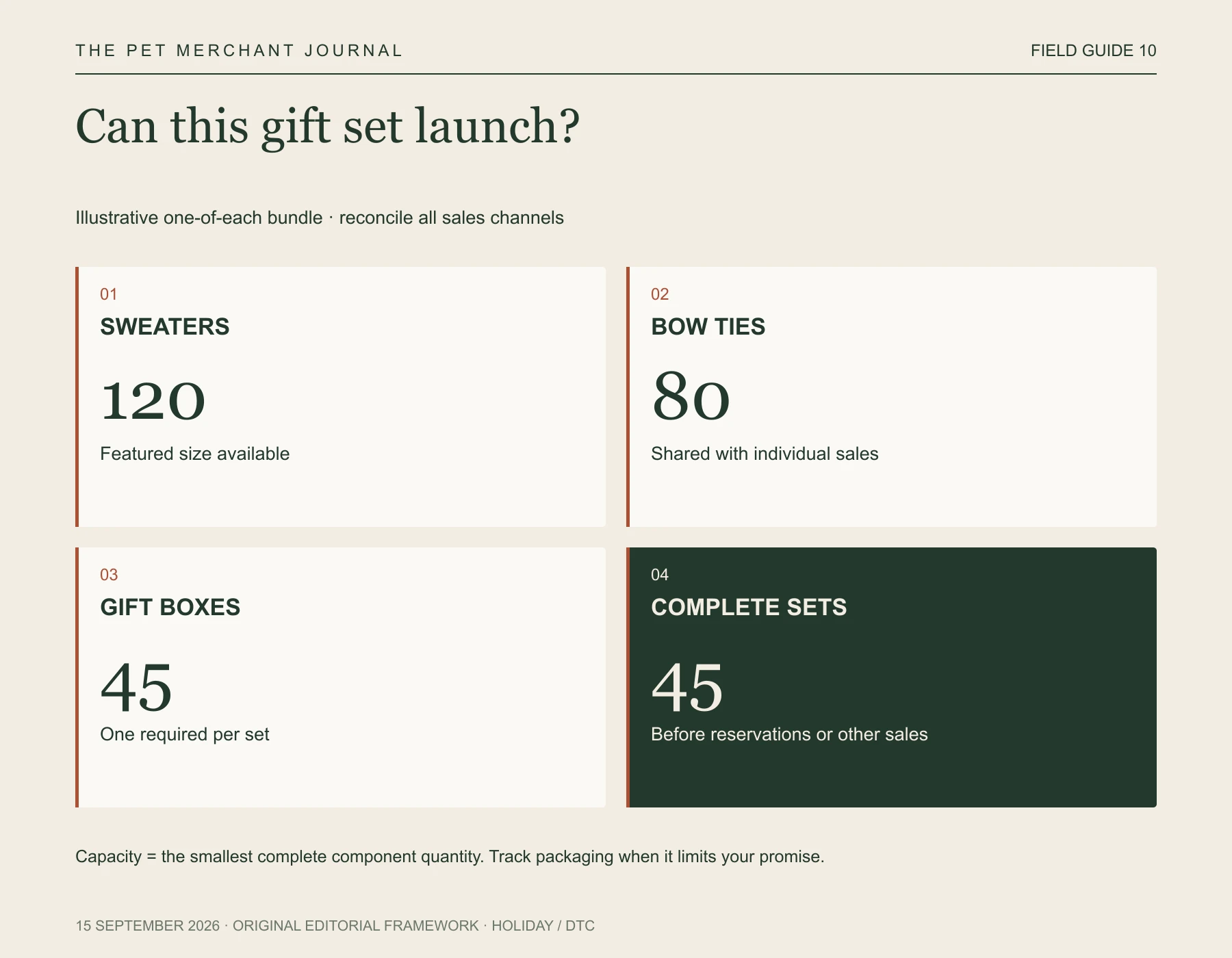
Original editorial framework. Capacity = the smallest complete component quantity. Track packaging when it limits your promise.
Price the finished promise.
Consider another explicitly illustrative calculation: a $42 set with $13 in product cost, $3 in packaging, $5 in pick-and-pack and delivery subsidy, $2 in assumed selling/payment fees, and a $2 expected return allowance leaves $17 before advertising and overhead. Actual fees and costs depend on the channel and business. These are planning numbers, not a pricing recommendation or a platform fee schedule.
If the assumed costs remain unchanged, a $6 discount takes that remainder to $11. The shopper sees a modest saving. The merchant has given up more than a third of the amount previously available for advertising and overhead. That may be a sensible decision, but the creative team should know which decision they are promoting.
Shopify's documentation also says that changing a component's price does not automatically update the bundle price. Assign an owner to review bundle pricing when product costs or component prices change; do not assume the assortment maintains itself.
Now commission the visual. Show the exact included items clearly, then photograph the packed presentation. Keep decorative objects outside the included-items image, or make their role unambiguous in the accompanying copy. A styled scene should never quietly turn an existing collar, a larger box, or an extra accessory into part of the offer.
If you explore outfit concepts with our project, Tufty, use those concepts to choose a visual direction before approving the final photographed set. An AI scene can help communicate a mood; the packed sample should determine the promise.
Before launch, ask a colleague unfamiliar with the set to choose a size, list the included pieces, and explain the delivery expectation from the page alone. This is a small clarity check, not a conversion experiment. Anything they need to ask belongs in the next revision.
Some products should remain individual purchases. A bundle that adds a second fit problem, consumes a scarce accessory, or hides weak economics may make an elegant image and a poor offer.
The best gift set makes the customer's decision easier and the merchant's promise more precise. The bow tie is part of both.